Enablement Is the Whole Game in Provisional Patents
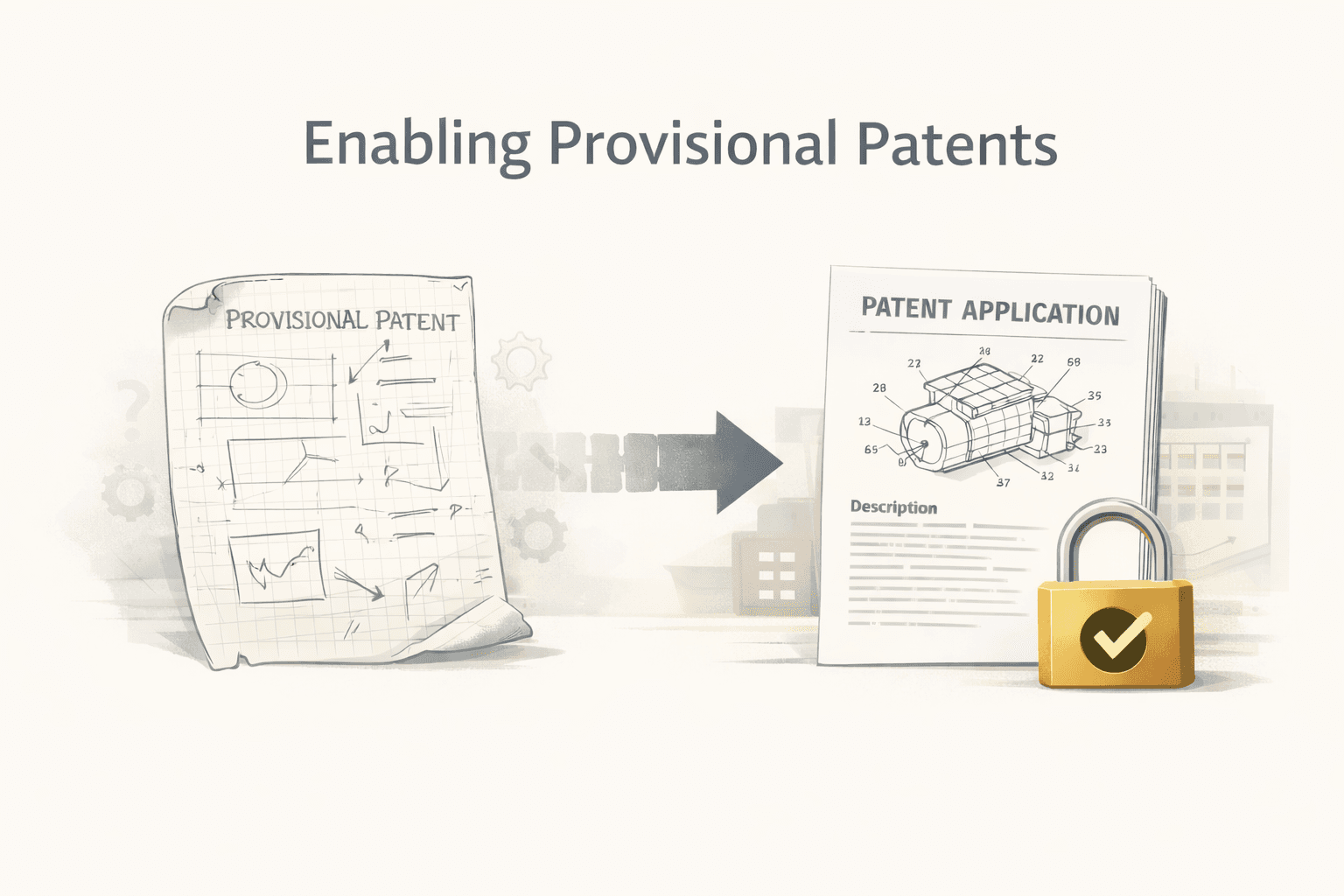
A provisional patent application is often described as a quick, low-stakes way to get “patent pending.” That framing is misleading. A provisional is valuable for exactly one reason: it can secure an earlier priority date for claims you pursue later in a non-provisional application. If the provisional does not fully enable those later claims, the priority date you thought you secured may not attach—meaning the provisional did not do its job.
This is the key nuance founders should internalize: a provisional does not meaningfully create “rights” in the ordinary sense. It creates priority rights—the ability to say, later, we had this invention on file as of that earlier date. But priority is not awarded for filing something early. Priority is awarded for filing enabling disclosure early.
Priority Rights Are Conditional
When you file a non-provisional and claim priority to a provisional, you’re making a factual assertion: that the earlier filing supports what you are claiming now. In prosecution, diligence, licensing discussions, or litigation, that assertion can be tested. If the provisional fails to support a particular claim—because critical details are missing, the invention is described only at a conceptual level, or key variations are not disclosed—then that claim may be treated as having the later non-provisional filing date.
For startups, that can be a catastrophic shift. An earlier date can be the difference between beating prior art and losing to it, between being first and being second, between preserving optionality and discovering you never had it. The risk is not that a provisional is “less formal.” The risk is that founders use it as an excuse to write less.
Enablement: What “Good Enough” Actually Means
Enablement is often summarized as “enough detail for someone skilled in the art to make and use the invention.” In practice, an enabling provisional does more than describe the idea. It lays out the implementation in a way that can support the claim scope you’ll want later. That requires at least four things:
Mechanism, not marketing. What are the components, steps, data structures, or system interactions that produce the result?
Working architecture. How does the invention operate end-to-end, including inputs, outputs, and the boundaries of the system?
Alternatives and variations. Different embodiments, parameter choices, and design options that keep claims from becoming brittle or narrow.
Failure modes and edge cases. The parts that demonstrate you understand the real engineering of the system, not just the happy path.
If your provisional reads like a product overview or a pitch deck, it is unlikely to be enabling for the claims that matter. Enablement is not about length; it’s about whether the disclosure is technically complete.
The Standard You Should Aim For: Verbatim Support
The best practice is simple and uncompromising: the provisional should verbatim support the non-provisional. Not “we can fix it later.” Not “we’ll add details when we convert.” Not “it’s obvious.” Priority is ultimately a text-based question: are the words (and supporting disclosure) there in the earlier filing?
This is why strong teams treat a provisional as a filing strategy, not a document strategy. “Provisional” can be the strategic choice to file now and refine the portfolio path over the next 12 months. It should not be a strategic choice to disclose less. The document should be drafted as if it might have to stand on its own, because in any serious priority dispute, that’s exactly what happens.
What Goes Wrong with “Thin” Provisionals
Thin provisionals tend to fail in predictable ways:
They describe outcomes (“the system automatically detects…”) without describing the mechanism that achieves them.
They omit key implementation constraints that later become essential to patentability.
They lack alternative embodiments, forcing later claims to rely on details that were never disclosed.
They treat “priority claim” as a magic wand rather than a supported legal position.
The practical consequence is not merely that the patent ends up narrower. The more serious consequence is that the earliest date becomes unreliable, which undermines the entire reason the provisional was filed.
Professional Mental Model for Founders
If you want a provisional to be worth anything, use this mental model:
A provisional is a non-provisional drafted early, filed early, and used to preserve optionality—provided it is enabling.
If you later need to file quickly, expand internationally, consolidate filings, pursue a continuation strategy, or defend your earliest date in diligence, you will be glad the first document was drafted as a real patent disclosure rather than a placeholder.
Bottom Line
A provisional patent application is not valuable because it exists; it is valuable because it can credibly anchor your priority date. That credibility comes from enablement. If the provisional does not fully enable the claims you’ll want later, you are not preserving rights—you are preserving a false sense of security. For startups, the right objective is not “file fast.” It’s “file fast with enablement, so the priority you think you bought is still there when it matters.”