Provisional Netting: Many-to-One Conversion Without Losing Priority
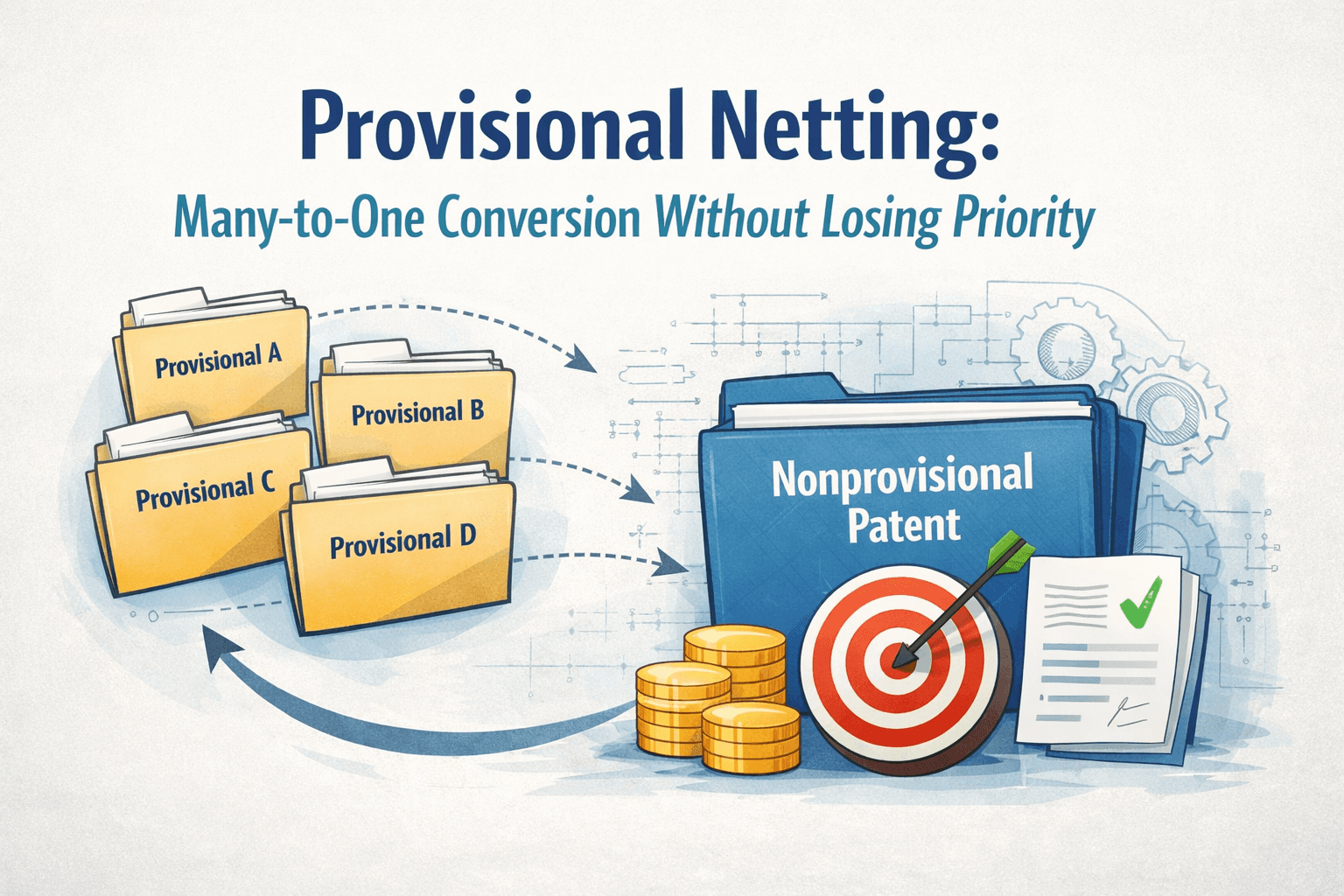
Fast-moving startups often file provisionals at the pace of discovery. The result is a familiar tension: you’ve captured multiple related inventions, but you don’t want to fund multiple parallel prosecutions just because you were diligent early.
Provisional netting solves that. It’s a many-to-one conversion strategy that preserves priority across a cluster of related provisionals while concentrating near-term prosecution spend into a single lead case—without sacrificing the option to pursue the others later.
When netting fits
Netting is designed for situations where you have:
Multiple fully enabled, related provisionals
Still within their 12-month windows (co-pending / alive)
A clear sense that not all deserve immediate prosecution budgets
In short: you want to keep the early dates, but you want to prosecute selectively.
The move
Pick the lead provisional
Choose the one with the highest perceived commercial value—the one you’d most want as your primary prosecution track.Convert it “as-is”
The nonprovisional should be a clean conversion: no new writing at conversion. (New matter defeats the point.)Claim priority to the full group
List the related provisionals in the priority claim to preserve the relevant dates.Also incorporate the others by reference
In addition to the priority claim, add explicit incorporation-by-reference language for the other provisionals. The priority claim preserves dates; the IBR language helps avoid treating the non-lead provisionals as effectively “invisible” unless a defect-cure doctrine is invoked.
The result: one nonprovisional you can prosecute now, with the rest preserved as optionality.
Why it works economically
Without netting, you convert and prosecute multiple nonprovisionals in parallel—multiplying drafting, office actions, amendments, interviews, and continuation decisions.
With netting, you run one lead case now and defer the rest until there’s a real business trigger.
That trigger often arrives later and more clearly than founders expect: competitor convergence, a roadmap pivot, diligence pressure, a licensing angle, or a manufacturing lock-in.
How you prosecute the others later
If one of the netted provisionals later proves valuable, you can pursue it through continuation practice:
File a continuation off the lead nonprovisional (while it’s still pending)
Use the netted provisional’s specification as the foundation for claims directed to that subject matter
Netting doesn’t abandon coverage—it defers prosecution spend while preserving the ability to “spin out” additional claim sets when the value justifies it.
The founder takeaway
Provisional netting is a portfolio discipline tool:
Preserve dates broadly
Prosecute narrowly
Expand later, on demand
Used well, it lets you build serious priority coverage without committing to a prosecution bill for every provisional the moment the clock hits 12 months.